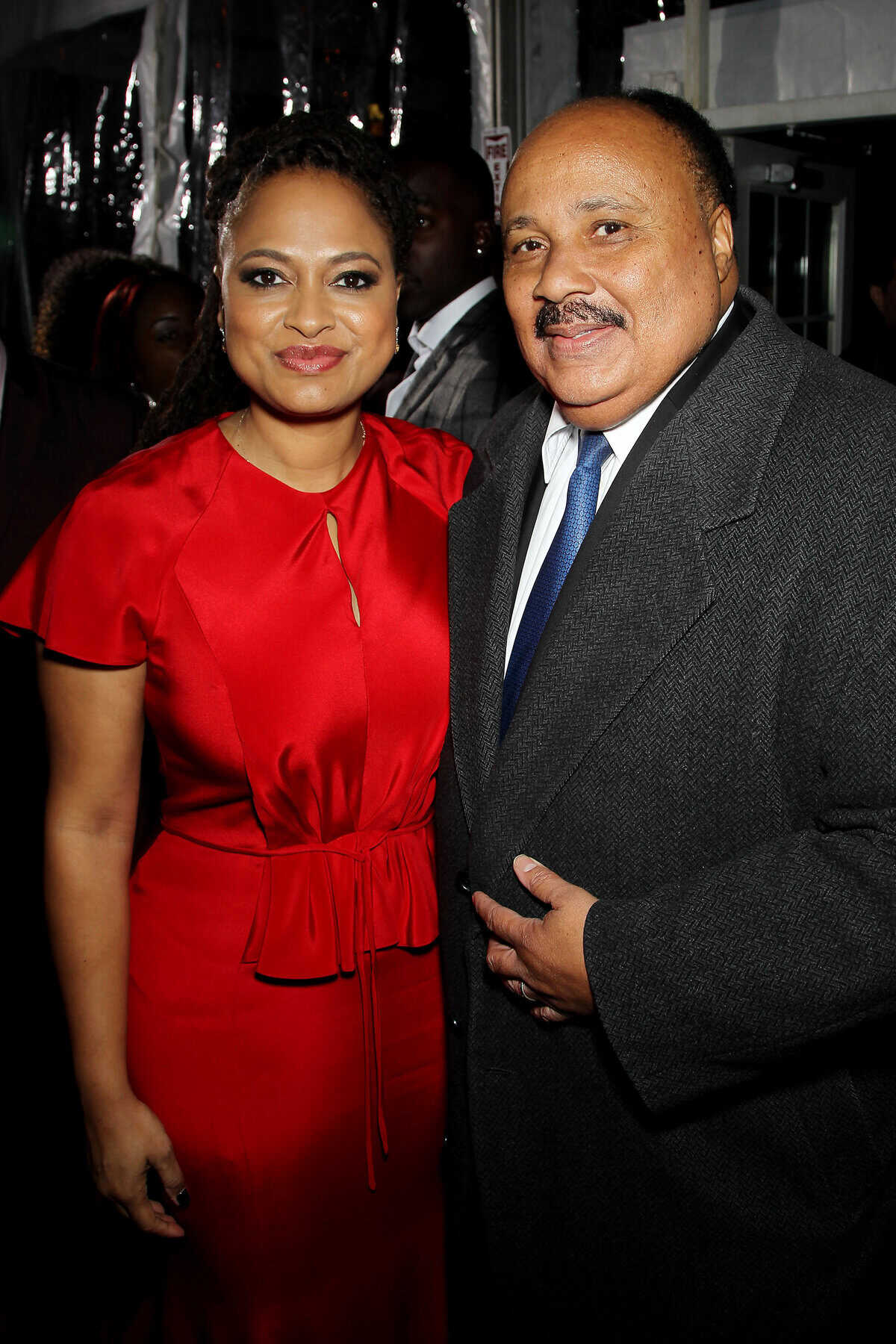
Director Ava DuVernay discussed her latest film “Selma” out Christmas Day.

Read what she told us exclusively about working with David Oyelowo, Carmen Ejogo, Oprah, meeting with Civil Rights leaders, humanizing Dr. Martin Luther King Jr. and why “Selma” is so relevant today.
Q: Tell me about collaborating with David Oyelowo and watching him transform into Martin Luther King Jr.
AVA: Yes, David is a chameleon, he can do anything, it’s so fun to work with him, he works in a way with his total mind, body and spirit and it’s beautiful to watch and it’s beautiful to participate in and as a partner in the performance and as his director, he’s a great guy.
Q: The legendary Oprah Winfrey is in the film. She’s acting, you are directing her and also she’s a producer. Speak about working with her in those capacities.
AVA: Yes as a producer, she was my guardian angel, my guide, she was with me every day, every step of the way, encouraging me, making a way for me. There are some rough patches when you are making a movie, she always made sure I had what I needed, that my vision was being protected, incredible. As an actor, I think she’s just an extraordinary actor who’s really underrated in that space because she’s so great at a lot of other things, but I enjoyed working with her. On the day she did her first scene, was the day her mentor Maya Angelou died, so it was a very emotional day and I said to her, we can reschedule, we can do it on a different day, and she said “No, I am going to do it for Maya.” She’s a strong lady, she’s focused, it was an honor to work with her.
Q: You said was it was important for you to show the women of the Civil Rights Movement in the film. Can you speak about that?
AVA: I’m getting a lot of attention for putting women in it, but shame on anyone who doesn’t have women in the story, because nothing could exist without us, so it’s ridiculous to even try, so when I got my hands on the project, definitely it was important and vital that the women of the movement be there. They are kind of written out of the history books, they are not as prominent in the Civil Rights history books as the men, but they were there and there in our film.
Q: Can you speak about your use of the FBI journal entries in the film?
AVA: COINTELPRO if you Google it, it’s fascinating. It’s short for the Counter Intelligence Program. It is a real thing where these civil rights leaders, black power leaders, from Malcolm X to the Black Panthers to the civil rights icons like Martin Luther King were surveilled, they were watched every second, there were bugs placed in their home by the government, they were being followed, it’s all public record and so it was important to make sure that people knew that.
Q: You also had Civil Rights Leaders involved in the film like John Lewis and Ambassador Andrew Young. Can you speak about meeting with these people who were on the forefront?
AVA: Yes, it was incredible. What an honor to be able to have the real people around to bounce ideas off of, to ask questions. They were so kind, they were so open, I can’t imagine someone trying to make a film about my life, I would be all up in their face and being like “No, I didn’t do it like that.” But no, they were very open to the interpretation of the events as I saw it as the artist and then just supportive of me … it’s hard for me to articulate how grateful I am.
Q: We have a very important hip-hop artist in the film, Common. Speak about working with him and his original song “Glory” just got nominated for a Golden Globe.
AVA: A VERY important hip-hop artist. I was having dinner with him just last night and I said to him, “You know the great thing about you in this film is that this film fits who you are as an artist, as a musical artist, as a hip-hop artist,” more than any other film that I think I have seen him in and he agreed. I felt like “Selma“ and what you will see in “Selma” is what he’s been doing and saying now for two decades almost. It’s really about the people, it’s evident in his pain, he’s really about the consciousness of being human on this planet and of course he’s one of our genius MC’s, so I think that he fits right in this character so well and in the song, really my heart swelled when he got nominated for that Golden Globe, and I know how much heart he put into that song with the orchestra behind him and his voice and John Legend, it’s just a really gorgeous moment for him.
Q: Congratulations on your Golden Globe, as well. You have made headlines because you are breaking boundaries. You are the first female African-American director to be nominated for this award. What does that mean to you?
AVA: First female African-American director to be nominated, but I am certainly not the best one that there is, you know there are beautiful women of color who have been making beautiful things for a long long time, so the fact that this body is recognizing me makes my mother very happy, but I know that there are a lot of great women that have gone before me, so it’s important to acknowledge them.
Q: This film is so relevant right now. We have people marching down the streets of New York City as we speak.
AVA: Yeah we were sitting in here doing interviews, and right outside yesterday I could hear the marches outside, while I was doing interviews about a film about marches and protests, and so this is nothing that we could have ever designed, imagined or even prayed for, or hoped for, that the world would be experiencing the very things that we talk about in our film, that this unrest is happening in Hong Kong, Mexico, the Middle East, Brazil and here in our very own backyard.
It’s happening in a way that people really feel and understand what happened in “Selma” and the hope is that people understand that this is not new, what we are experiencing now, that the same thing happened before and before that and before that, til we stop and break this stuff down, really don’t gloss over it, but deconstruct it, to find answers and to fix it, then the same thing is going to happen in another fifty years or another two years, so the hope is that “Selma” just gives some historical context to the current moment and maybe helps in the conversation.
Q: You also tackled this challenge of humanizing Dr. King, can you speak about that.
AVA: Yeah, you have never seen a film at the theatres with King at the center of it. There’s never been one made, which is a damn shame and ridiculous and criminal and so we are doing it in a way that we hope deconstructs what you have read in the history books and makes him more than just a catch phrase, a speech. “I Have A Dream” wasn’t even the best speech … but would you want to be relegated to four words in your whole life to encapsulate who you were. I mean he was a radical, a brilliant speaker, he was a man of faith , who was sometimes unfaithful, he was guilty, he was depressed, he had an ego, he loved to eat, he was a prankster, he was charismatic, he was dynamic. That is what human beings are and shame on us for locking people in statues, and making them be one thing for their whole life, so that was really my goal, it was to break that apart.
Q: What most surprised you about Dr. King in your research?
AVA: I grew up in Compton, so I am kind of a black panther and Malcolm X ideologist, like that’s the kind of thing that I grew up on, those theories, as to how to address the issues of black people in this country, maybe more aggressive, I thought at the time. But in really researching this time, I found that the things that I thought about nonviolence, which it was very faith based, they are non-violent because they are preachers, it was really not the only reason why they were practicing nonviolence, it was strategic, they know that one BB gun cannot go up against a tank, so what do you do? What are the ways around it, that wasn’t purely steeped to church ideology, that it was steeped in actual freedom fighting tactics, about how to engender empathy and how to combat aggressive police violence.
Q: You also had the opportunity to shoot on the very bridge and the locations where the protesters marched. Can you speak about recreating those moments?
AVA: There is something very energetic that was happening in real places that helped the actors and certainly helped me, we didn’t have to imagine what it felt like because we were actually on the ground where blood was spilled, we were on the ground where Dr. King made that final speech. For David as the actor to be able to step into that moment to see the exact street that Dr. King was looking at, the moment that he said those words, those were the kinds of chemical reactions that you can’t direct.
Q: I’d also like to hear about working with Carmen Ejogo to bring Coretta Scott King to life.
AVA: Yeah she played Coretta when she was in Montgomery Bus Boycotts, that was ten years ago, ten years later she plays Coretta, actually ten years later in Coretta’s trajectory, during this time and she’s really grown with the character and she knew where it was before, where she’s gone and she was able to just really tap into the quiet dignity of Coretta in a way that I think is just sublime. She did so much hard work to make it more than just ”the wife” and to really make her a partner in the scenes with King and that she did splendid.
Q: And also we have great emerging talent in the film like Tessa Thompson. She had a great year with “Dear White People,” as well.
AVA: I love working with Tessa, I think she’s one of our best and brightest. She’s a real actor, she’s not just a pretty face. I mean she really is a gorgeous spirit, a hard worker, an intellectual, an amazing personality, all the things that a director wants to have on the set, I can’t wait to work with her again.
