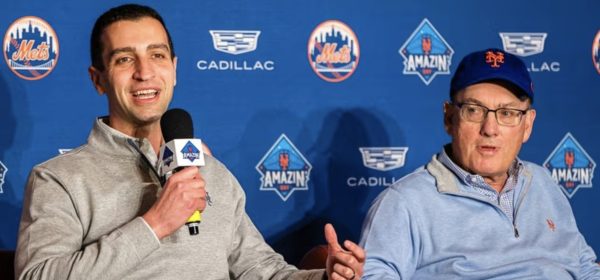
With the dust barely settled on the 2025 season, the New York Mets are looking unrecognizable. Stripped of core players, burdened by financial and draft penalty consequences, and scrambling to rebuild ahead of 2026, many fans have zeroed in on President of Baseball Operations David Stearns as the architect of the chaos. The calls for his firing have grown louder with each departing player and each missed opportunity.
The biggest blow arrived on December 10, when former franchise cornerstone Pete Alonso signed a five-year, $155 million deal with the Baltimore Orioles. Alonso leaves Queens as the Mets ‘ all-time home run leader, fresh off a season where he played all 162 games, hit .272 with 38 homers, and drove in 126 runs. Stearns never made a formal offer. For many, that was the final straw.
But the hemorrhaging did not stop there. Earlier in the offseason, the team said goodbye to star closer Edwin Diaz, who landed a three-year, $69 million deal with the Los Angeles Dodgers after posting a 1.63 ERA, 28 saves, and 98 strikeouts in 66.1 innings. The departure of Brandon Nimmo only deepened the wound. In a matter of weeks, the Mets had lost their middle-of-the-order power, their late-inning reliability, and two of the most visible faces of the franchise. Fan morale, already fragile after yet another failed postseason push, cratered. The tone in Queens shifted from “Next year is ours” to “What are we even doing?”
All of this unfolded during MLB’s Winter Meetings in Orlando, the offseason battleground where aggressive teams reshape their futures. For the Mets, it became a stage for departures and downsizing rather than bold additions. Stearns’ moves were met with frustration, not excitement.
Among the few signings, right-handed reliever Devin Williams arrived on a three-year, $51 million contract meant to stabilize the back end of the bullpen. Veteran Carl Edwards Jr. joined on a minor league deal as depth. Useful, but hardly enough to offset the exits of Diaz, Nimmo, and Alonso. Rumors surfaced that the Mets made exploratory calls on Pirates starter Mitch Keller, but nothing has materialized. With Stearns’ track record this winter, fans are skeptical that anything will.
The front office shakeup extended beyond the roster. During the same Winter Meetings, longtime scouting director Tommy Tanous left to become assistant general manager of the Colorado Rockies. Tanous’ exit raises serious concerns about continuity in amateur scouting and player development, especially at a time when the Mets desperately need stability in their pipeline.
To make matters worse, MLB penalized the club for exceeding the Competitive Balance Tax threshold in 2025, dropping their 2026 first-round pick ten spots to number 27 overall. The timing could not be worse. With the farm system weakening and the major league roster in transition, losing premium draft position only widens the gap between where the Mets are and where they claim they want to be.
Looking ahead to 2026, the Mets are facing a roster with more questions than answers. With Alonso gone and no comparable bat added, the team may be forced to rely on internal stopgaps or low-risk signings at first base and in left field. The bullpen will hinge on Devin Williams rediscovering his elite form, while Carl Edwards Jr. profiles more as an innings patch than a difference maker. Whether Mitch Keller or another rotation arm arrives is still uncertain.
Meanwhile, the diminished draft capital and the departure of Tommy Tanous threaten the long-term outlook just as much as the present. The franchise is losing both talent and the ability to replenish it.
Owner Steve Cohen tried to steady the fanbase, insisting, “There’s a lot of offseason left to put a playoff team on the field.” But optimism in Queens is fading with each headline and each move the Mets don’t make. Fans do not see a retool. They see a teardown without a blueprint.
And that is why the criticism of David Stearns has escalated from frustration to fury. Fair or not, he has become the face of the Mets’ unraveling. The roster looks thinner, the farm system weaker, and the direction murkier than ever.
At this point, the Mets don’t need hype or PR polish. They need clarity. Who is stepping up as the new foundation? What is the actual plan for 2026 and beyond? And the most pressing question: does the front office still remember what it means to wear blue and orange?
Because right now, the fanbase is wondering if anyone in power truly does.