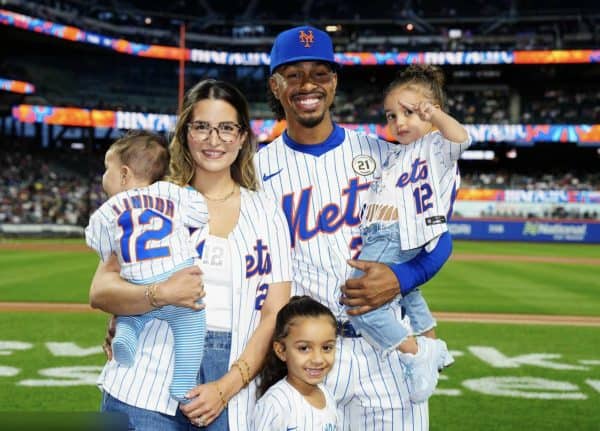
New York Mets shortstop Francisco Lindor has found himself adjacent to the city’s political conversation after reports confirmed that his wife, Katia Reguero Lindor, is a member of New York City Mayor elect Zohran Mamdani’s inaugural committee.
The news, first reported by New York Post Sports, places Reguero Lindor among a select group tasked with helping organize and support events surrounding Mamdani’s swearing in as mayor. The inaugural committee is designed to reflect the city’s cultural and professional diversity, drawing from figures across arts, activism, media, and civic life.
Katia Reguero Lindor is a classically trained violinist and podcast host known for her work centered on parenting, women’s health, and social advocacy. She and Lindor were married in 2021 and are parents to three children. While Francisco Lindor has largely kept his public focus on baseball, his wife has been more visible in advocacy driven spaces, making her inclusion on the committee consistent with her prior public engagement.
Mamdani’s team released a formal list of committee members ahead of the January inauguration, confirming Reguero Lindor’s role alongside a wide range of New York based cultural and political figures. The committee is expected to assist with planning events that emphasize community representation, accessibility, and a broad cross section of the city’s population as Mamdani prepares to take office.
The connection has sparked conversation among Mets fans and sports media, particularly given Lindor’s status as one of the franchise’s cornerstone players. While Francisco Lindor himself is not involved in city politics, his visibility as a high profile athlete means any association connected to his family tends to draw attention, especially in a market like New York where sports and civic identity often intersect.
From a baseball standpoint, the timing is notable but largely incidental. Lindor remains focused on the upcoming season, continuing his role as the Mets’ everyday shortstop and one of the team’s primary leaders. Since joining the organization, he has been a central figure both on the field and in the clubhouse, valued for his defense, durability, and presence in pressure situations.
Neither Lindor nor the Mets organization has publicly commented on Reguero Lindor’s committee appointment, and there is no indication that her involvement has any bearing on team matters. Still, the development underscores how athletes and their families are increasingly visible beyond the confines of sports, particularly in cities where cultural influence extends into politics, media, and public discourse.
As Mayor elect Mamdani prepares to formally take office, the inaugural committee’s role will remain largely ceremonial and organizational, focused on ushering in the next administration rather than shaping policy. For Lindor, the moment represents another example of how life in New York inevitably blends professional, personal, and civic worlds, even when the athlete himself remains squarely focused between the lines.
For now, the story stands as a brief but notable crossover between baseball and city politics, one that highlights the expanding public footprint of athletes’ families in modern New York.