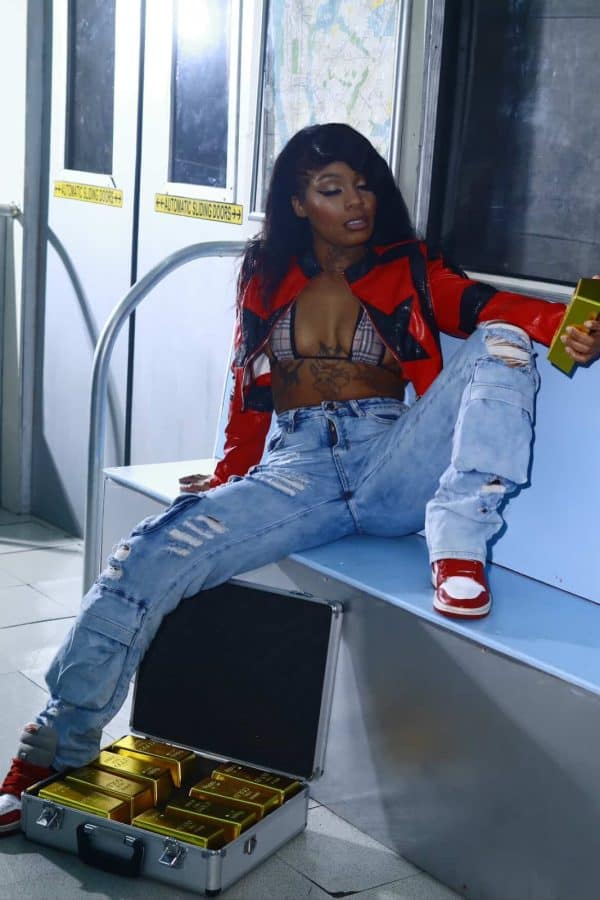
For Saki, a multifaceted artist hailing from Inglewood, creativity has never been optional—it has been essential. Before language gave shape to her emotions, movement did. Through ballet, hip-hop, and jazz, she learned how to communicate feeling with her body. By the age of fourteen, that physical expression transformed into words, filling notebooks with lyrics rooted in honesty, introspection, and lived experience.
Raised by the rhythm of her city and strengthened by life’s transitions, Saki’s artistry reflects evolution. Her journey has been shaped not only by performance and sound, but by motherhood, resilience, and an unwavering commitment to self-expression. Today, she stands as an artist who leads with emotional intelligence—unafraid to reveal softness, strength, and contradiction in the same breath.
A Calling That Came Naturally
For Saki, becoming an artist was not a career decision—it was a natural unfolding. Music has always been her refuge, a space where she felt understood long before the world caught up.
“Creating has always been the one place where I felt completely understood,” she shares. “Music raised me, protected me, and gave me a place to put emotions I didn’t have words for yet.”
That connection to creation remains the foundation of her work. Music is not simply what she does—it is how she processes life, identity, and emotion.
Introducing ‘Perfect’: A Softer Chapter
Saki’s upcoming single, “Perfect,” marks a deeply intimate chapter in her artistry. Vulnerable and emotionally transparent, the record explores the complexity of letting someone in, only to be reminded why emotional walls were built in the first place. It is a song about love, fear, miscommunication, and the quiet pain of things left unsaid—created in real time, from real emotions.
With “Perfect,” Saki invites listeners into a more delicate space—one that contrasts with the bold, femme-forward energy often associated with her image. The single signals growth, emotional honesty, and a deeper connection with her audience.
Interview with Saki
Q: For readers discovering you for the first time, who is SAKI—and what defines you as an artist beyond the music?
SAKI leads with awareness and intention. I draw from real experiences—love, growth, motherhood, and self-reflection—but I’m selective about what becomes art and what remains personal. I don’t completely separate who I am from what I make, but I also don’t create impulsively. Beyond music, I’m a dancer, a mother, and a woman who values clarity as much as expression.
Q: Many outlets are already calling you one of the most exciting artists to watch in 2026. What do you think sets you apart in today’s crowded music landscape?
I move with intention. I don’t rush output or chase relevance. I take time to understand what I want to say and why it matters. I don’t try to fit the industry—I force it to adjust.
Q: Your image and sound strongly reflect a modern femme fatale—confident, seductive, powerful. What does the femme fatale identity mean to you personally?
To me, the femme fatale represents reclaiming your womanhood. It’s taking the negative myths placed on women and transforming them into sources of spiritual and emotional strength. A femme fatale moves with confidence, effortless attraction, and strong boundaries. She stands firmly in her own energy while remaining self-aware enough to know she’s always a work in progress.
Q: Take us back to the beginning—how did your journey into music first start, and when did you realize this was more than just a passion?
Music started as a way to process my thoughts before I had the language to explain them. When people began telling me that what I had to say needed to be heard, I leaned into it. Building a home studio at seventeen showed me I was willing to do whatever it took. That’s when I realized this was bigger than a hobby.
Q: How has your sound evolved since your earliest recordings to the artist we’re hearing today?
Early on, I was exploring. Now, I’m decisive. I understand restraint and when to let something breathe instead of pushing it. Songs like Kill Bill and Perfect show different sides of me, but both are intentional.
Q: Who are your biggest musical inspirations, and how have they influenced your sound, visuals, or confidence as an artist?
I’m inspired by artists who moved with conviction—Eve, Tech N9ne, MGK, Tupac, and Kendrick Lamar. They didn’t dilute who they were to be accepted, and that gave me confidence to trust my own voice.
Q: As a female artist, how do you navigate power, perception, and authenticity in an industry that often tries to define women for you?
By staying grounded in self-trust. I listen, but I decide what applies. Power is discernment—knowing when to engage and when to step back. I don’t feel the need to over-explain myself.
Q: What can fans expect from you as we move into 2026—, visually, and personally?
Consistency and growth. The music will feel more focused and intentional. Visually, everything will feel aligned and natural. Personally, I’m choosing my direction with confidence