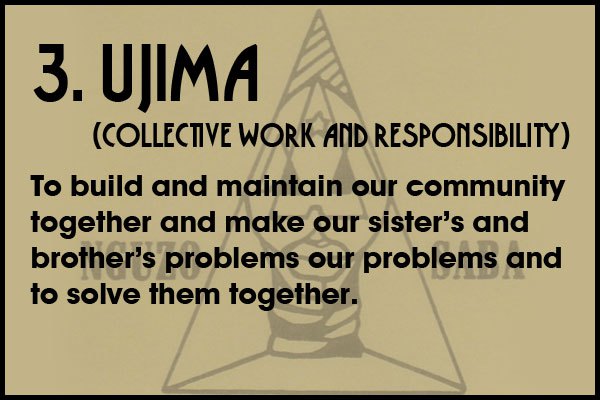
Ujima, the principle of Collective Work and Responsibility, centers on the belief that strong families and healthy communities are built through shared effort. It reminds us that individual well being is inseparable from the condition of our neighborhoods and the people who live within them. When one family struggles, the community feels it. When a community thrives, families are strengthened. This is the living meaning behind the idea that it takes a village.
Ujima calls on each person to take responsibility for the mental, physical, and spiritual health of both their household and their community. It challenges us to move beyond isolation and recognize that progress is most sustainable when it is collective. Through cooperation, accountability, and care for one another, we ensure that no one is left behind and that success is shared rather than hoarded.
By embracing Ujima, we affirm that the advancement of the individual is tied directly to the strength of the whole. Collective responsibility creates stability, trust, and resilience, allowing communities to meet challenges together rather than fragment under pressure.
Collective Work and Responsibility Day offers an opportunity to put this principle into action. Families and communities are encouraged to reflect on the Kwanzaa symbol of Muhindi, or corn, which represents children and the future. It serves as a reminder that what we build today shapes the lives of the next generation.
The day is best centered around family, emphasizing cooperation and togetherness. Sharing a special meal, whether at home or within the community, reinforces unity and provides space for meaningful connection. Working collectively on a project, such as cleaning a shared space, creating something of value, or addressing a local need, allows the principle of Ujima to move from concept to practice.
Ujima also encourages offering support where it is needed most. Helping a family member, friend, or neighbor through a difficult moment reinforces the idea that responsibility does not stop at one’s own door. Whether through practical assistance, emotional support, or shared problem solving, every act of care strengthens the collective.
By honoring Ujima through intentional action, families and communities contribute to an environment rooted in cooperation, dignity, and shared purpose. In doing so, they help build a foundation where everyone has the opportunity to grow, supported by the strength of the village around them.