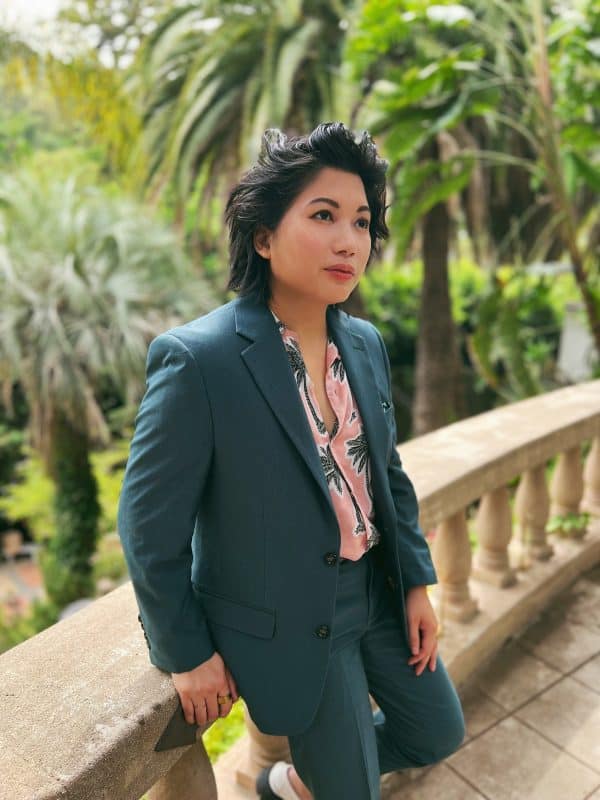
The lines between film, digital storytelling, and audience engagement have never been more blurred. For Sonia Hong, an award-winning filmmaker and creative director, this isn’t a challenge—it’s the space where she thrives. Her career has unfolded at the intersection of traditional cinema and emerging media, blending cinematic craftsmanship with a deep understanding of how people engage with stories in real time.
“I’ve always been drawn to the spaces where art and technology intersect,” Hong says. “Film has a kind of permanence—a meticulous, crafted world that exists on its own terms—while digital media is about immediacy, participation, and evolution.”
Hong’s path began in production design before moving into directing, then digital production and livestreaming. Along the way, she learned to see audience behavior as a crucial part of storytelling. People weren’t just passive viewers anymore; they were shaping conversations in real time. That shift—one where stories are constantly in dialogue with their audience—became a defining force in her creative approach. Now, as she pivots back into film and TV, she’s bringing those insights with her. The goal? To tell stories that don’t just entertain but tap into something deeper: identity, culture, and the way we navigate intimacy and connection in an era where everything feels both hyperconnected and isolating at once.
Cinema Without Borders
Hong’s projects have ranged from high-profile commercial collaborations to deeply personal work, but the throughline is clear: she is drawn to storytelling that challenges the status quo. WAACK REVOLT, her award-winning short film, exemplifies this. Part documentary, part dance film, the project explored the revolutionary roots of waacking—a dance form born from the underground queer and BIPOC communities of 1970s Los Angeles.
“It wasn’t just about dance—it was about resilience, joy, and community,” Hong explains. “When you tell something specific and true, it resonates universally.”
On the other end of the spectrum, her work on Unboxing Wakanda Forever was a masterclass in honoring a cultural moment in real time. Collaborating with Target on a livestream campaign surrounding Black Panther: Wakanda Forever, Hong was acutely aware that this was more than just a brand activation—it was about celebrating Black representation in blockbuster cinema and honoring the legacy of Chadwick Boseman.
“It was an honor to work with stakeholders who weren’t just interested in ‘getting it right,’ but in making space, elevating the right voices in the right moments,” she says. “Black Panther wasn’t just a movie—it was a seismic cultural shift. To do it justice, the storytelling had to be built from the inside out.”
Hong also understands the high-wire act of live storytelling better than most. Working on MrBeast’s first Creator Games, one of the first massive livestreamed charity events of its kind, she orchestrated a digital spectacle that needed to run seamlessly in real time. Featuring some of the biggest YouTube creators (and a chaotic, delightful Jack Black), the production was already ambitious. Then, midway through the event, disaster struck: the stream was hacked.
“One of the contestants had inadvertently broadcasted the join link to their millions of followers, and suddenly, the backend was flooded with unauthorized users,” Hong recalls. “We had to react instantly—cut the breach, stabilize the show, and keep the energy alive. We got it back up in record time.”
The event went on to raise over $1 million for the World Health Organization and won a Streamy Award for Best Live Special. But beyond the numbers, it reinforced something crucial for Hong: live digital storytelling, when done right, can create truly electric moments—just as high-stakes as a scripted drama.
The Next Chapter: Redefining Representation
As she develops her next narrative project—a series centered on young female friendships—Hong delves deeper into the question of what makes a story feel real. The project explores self-mythology, friendship, and the unsettling disorientation of navigating a world where reality is performative, algorithm-driven, and increasingly blurred by AI.
“At its heart, it’s about friendships, and with that comes a responsibility to examine what’s real and what’s just another construction,” she explains. “What makes an ‘odd couple’ compelling versus a pair who would never actually be friends? What relationships reflect the way people truly connect, and what’s just another trope we could do without?”
Hong has long been mindful of the delicate balance between representation and tokenization. Long before drag became mainstream, she was making films about queens—from campy musicals to a docu-style pilot that explored the social and financial pressures of what was then a highly niche subculture. Even then, she knew that true representation didn’t mean showcasing people—it meant making work with them.
“That same philosophy drives my work today,” she says. “Representation can’t be an aesthetic choice—it has to be felt. That means asking: What are the real textures of a culture—its food, music, pressures, familial hierarchies, inside jokes? How do those things shape a character’s worldview, their relationships, their place in the story? If you don’t root representation in truth, all you’re left with is a checklist.”
She also rejects the idea that representation needs to be overexplained.
“I believe identity doesn’t have to wave a flag or explain itself—it can just be,” she says. “Some of the most powerful moments happen when identity isn’t a plot device or a conflict to overcome, but an undeniable, lived-in part of the world you’re building.”
Filmmaking in an Evolving Landscape
Hong is the first to acknowledge that the language of cinema is expanding, and rather than resisting that shift, she embraces it.
“Audiences have developed an incredible visual literacy—they instinctively recognize strong composition, pacing, and emotional depth, whether they’re watching a film in a theater or a scene on their phone,” she says. “The challenge isn’t in adjusting to different formats; it’s in ensuring that storytelling remains rich, layered, and cinematic, no matter where it lives.”
She’s also paying attention to how audiences engage with stories beyond just watching them. With her new series, for example, she’s thinking about digital narratives—how people construct their identities online versus in real life, and what happens when those two versions collide.
“The most interesting work is happening at the intersection of film, digital culture, and audience participation,” she says. “I don’t think storytelling is passive anymore. The best films don’t just respond to what’s happening now—they challenge it, complicate it, and shape what comes next.”
And if there’s one thing that has remained consistent throughout Hong’s career, it’s this: a refusal to be bound by what’s already been done.
“I’m always looking beyond the obvious,” she says. “The most interesting shifts in culture don’t start at the top; they emerge in underground art scenes, independent films, experimental music, and niche online communities before making their way into the mainstream. That’s where I look for inspiration—not to follow trends, but to understand why something resonates.”
Because, at the end of the day, the most exciting stories aren’t just a reflection of the present. They’re the ones shaping what comes next.