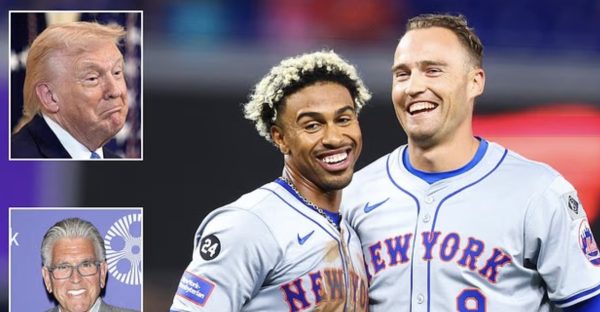
Mike Francesa ignited discussion this week after claiming that political differences were at the center of tension between Francisco Lindor and Brandon Nimmo inside the New York Mets clubhouse. Speaking on The Mike Francesa Podcast while assessing the organization’s outlook ahead of the 2026 season, Francesa suggested that opposing views about President Donald Trump created a divide between two of the team’s most prominent leaders.
Francesa framed the situation bluntly, stating, “The Nimmo Lindor thing, my understanding was political. Had to do with Trump. One side liked Trump, one side didn’t like Trump. So Trump’s splitting up the Mets between Nimmo and Lindor. That’s my understanding. It started over Trump, as crazy as that sounds. Crazier things have happened.”
The comment came during a broader conversation about the Mets uncertain future. Francesa noted that the team could soon look dramatically different following the departures of Edwin Diaz, Pete Alonso, and possibly Nimmo, while even Lindor’s long term presence was framed as no longer guaranteed. “The Mets are going to have a completely new look,” Francesa said. “The idea that they could come back and not have Diaz, Alonso, Nimmo, and maybe even Francisco Lindor tells you that they are a completely different team.”
While Francesa acknowledged that clubhouse friction is nothing new in professional sports, his suggestion that politics played a role struck a chord. In an era where players are more open about their identities and beliefs, it is not unrealistic that ideological differences could surface, even among teammates working toward the same goal.
Lindor and Nimmo both carried leadership weight during a turbulent period for the Mets. Lindor arrived as a franchise cornerstone expected to set the tone both on and off the field. Nimmo, a longtime homegrown presence, was often viewed as the emotional constant in the clubhouse. When players occupying that level of influence are not aligned, even quietly, the impact can be felt beyond private conversations.
It is also important to approach Francesa’s claim with perspective. Neither Lindor nor Nimmo has publicly addressed the allegation, and the Mets organization has never confirmed politics as a source of internal division. Clubhouse dynamics are layered and rarely hinge on a single issue. Performance struggles, media pressure, contract uncertainty, and leadership expectations often play a larger role than fans ever see.
Still, Francesa’s comments underscore how the modern clubhouse reflects the world outside it. Teams are no longer insulated spaces, and disagreement does not always stay separate from competition. As the Mets continue to reset their identity, the conversation serves as a reminder that chemistry is fragile, leadership is complex, and winning remains the great unifier.
Whether rooted in politics or not, the Lindor Nimmo storyline illustrates how quickly internal tension can become part of a larger narrative when expectations go unmet and stability erodes.