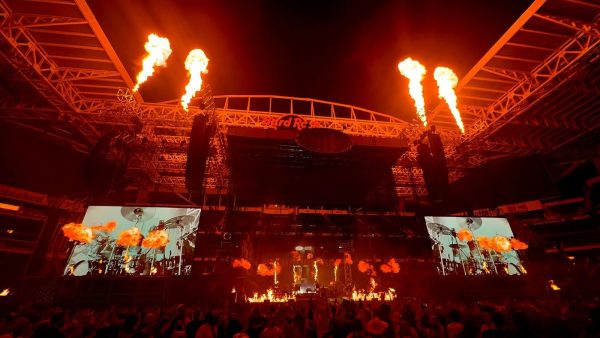
Post Malone at Hard Rock Stadium (Image: Concert Stuff Group)
Live music has never relied on more moving parts. Tours have grown larger, festivals have multiplied, and the technology involved has only grown more complex. Despite that, audiences still expect smooth experiences that hide the infrastructure required to make them happen. The companies that make that possible often work in silence, and few operate with more reach than Concert Stuff Group. Its crews stand behind many of the largest productions in hip-hop and R&B, yet the name remains unfamiliar to most fans who walk across its stages without ever noticing.
What has raised CSG’s profile inside the industry is how it has started to unify a field that has long been scattered. Over the past year, the company has assembled a far wider network, acquiring six firms and bringing staging, lighting, audio, transport, flooring, and crowd barriers under one structure. Touring has traditionally depended on juggling separate vendors with separate workflows. CSG has been moving in the opposite direction by shaping a single national model that treats production not as a chain of transactions but as one continuous system.
That shift has helped the company deepen its role in hip-hop and R&B, where large tours often hinge on whether staging and infrastructure can scale without breaking rhythm. Artists like SZA, Chris Brown, Post Malone, Kendrick Lamar, Playboi Carti, Burna Boy and NBA Youngboy have all relied on CSG teams as well as festivals from Rolling Loud to Roots Picnic and Governors Ball. Their shows need precision more than flash, and CSG has built a reputation for supplying the technical backbone that keeps those performances consistent from night to night. The company now supports 75% of Billboard’s top one hundred artists, rooting it deeply in the production landscape.
Chris Brown at National Park (Image: Concert Stuff Group)
Festivals offer another window into the company’s reach. Rolling Loud, the largest hip-hop festival brand in the world, depends on structures that can be delivered, assembled, and cleared at a pace that leaves little room for hesitation. The scale of the event requires heavy infrastructure and fast decision-making, and CSG supplies much of the staging and support that lets the festival move forward without visible strain. It is the kind of environment where a small delay can cascade into a major setback, yet CSG’s crews are expected to keep the schedule intact.
The company has also shown how this model works when speed matters more than anything else. Concert for Carolina, organized after Hurricane Helene, needed to come together quickly and still meet the standards of a stadium show. CSG helped make it possible, and the event drew more than 82,000 attendees while raising nearly $30M for relief efforts. The concert demonstrated that a national operation can still move with the responsiveness of a smaller shop, which has become one of CSG’s defining advantages.
That capability is not accidental. It comes from nearly four decades of building toward a cohesive structure. CSG traces its roots to 1986, when founders Jim Brammer and Jeff Cranfill launched Southern Light in Winston-Salem. The company later evolved into Special Event Services before expanding into the broader network now known as Concert Stuff Group. The history matters because it explains the company’s foundation, a long accumulation of technical experience that supports its current push to bring more of the production pipeline under one roof.
The next step in that plan is underway in North Carolina, where CSG is developing a 70-acre campus in Mocksville anchored by a new 52,000 square foot SES facility. The site will centralize equipment, rehearsal areas, fabrication, and logistics teams, giving artists a single place to refine and prepare their shows before taking them on the road. As stadium tours rely on increasingly complex builds, the ability to design and test everything in one location has become more valuable.
As the company approaches its fortieth year, its presence remains mostly invisible by design. CSG is not a name on the marquee, yet its work shapes much of what audiences experience. The goal is consistency, not recognition. If the night unfolds smoothly, the crowd never thinks about the barricade beneath them or the structure above them. They watch the show, unaware of the system running around them, which is exactly how CSG prefers it.