
Kanye West is being acknowledged for his role in bringing national attention to the case of convicted gang leader Larry Hoover, whose federal sentence has now been commuted by former President Donald Trump.
In a recent interview with TMZ, Larry Hoover Jr. credited West for initiating key efforts that helped elevate his father’s case to the highest levels of government. “He had a very big part because he started it all off,” Hoover Jr. said. “He put us on the platform. He took us to the White House on his platform when he didn’t have to do that.”
He went on to praise the artist for using his influence on behalf of his father’s cause. “We know he doesn’t have a problem with sticking his neck out there for what he believes in, and I’m glad he believed in this.”

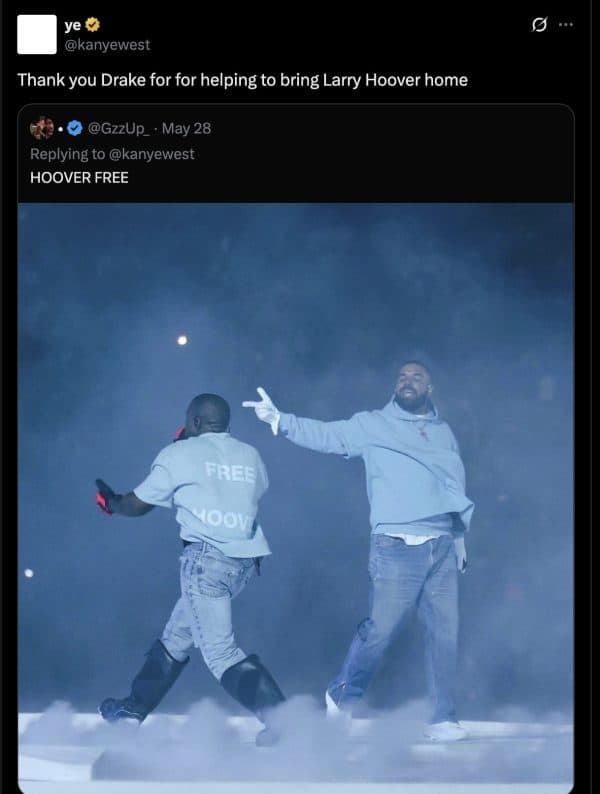
Following the announcement of Hoover’s commutation, Kanye West expressed his gratitude in a statement shared on X (formerly Twitter), writing, “WORDS CAN’T EXPRESS MY GRATITUDE FOR OUR DEVOTED ENDURING PRESIDENT DONALD TRUMP FOR FREEING LARRY HOOVER.” He also thanked Drake, noting, “Thank you Drake for helping to bring Larry Hoover home.”
Larry Hoover, the reputed founder of the Gangster Disciples, has been incarcerated for over five decades. He was initially convicted in 1973 for orchestrating the murder of a Chicago teenager. He was later sentenced in 1997 to six additional life terms after being found guilty of federal charges, including drug conspiracy, extortion, and money laundering.
Despite Trump’s commutation of his federal sentence, Hoover remains entangled in a separate 200-year state sentence related to the 1973 murder conviction, which a presidential pardon cannot overturn. Nonetheless, reports indicate that Hoover may soon be transferred from the maximum-security ADX Florence facility in Colorado to a lower-security prison in Illinois.
In 2022, Hoover submitted a letter to the court as part of a resentencing effort, denouncing his former criminal affiliations and attempting to redefine his public image. “I am no longer the Larry Hoover people sometimes talk about, or he who is written about in the papers,” he wrote. “I have long since renounced my association with any and all criminal organizations and their membership. I am no longer a member, leader, or even an elder statesman of the Gangster Disciples. I want nothing to do with it now and forever.”
Hoover’s case remains one of the most controversial in recent memory, stirring debate over redemption, rehabilitation, and the intersection of celebrity influence and criminal justice reform. As his legal battle continues, advocates hope his commutation marks the beginning of broader conversations around second chances and systemic change.